Research
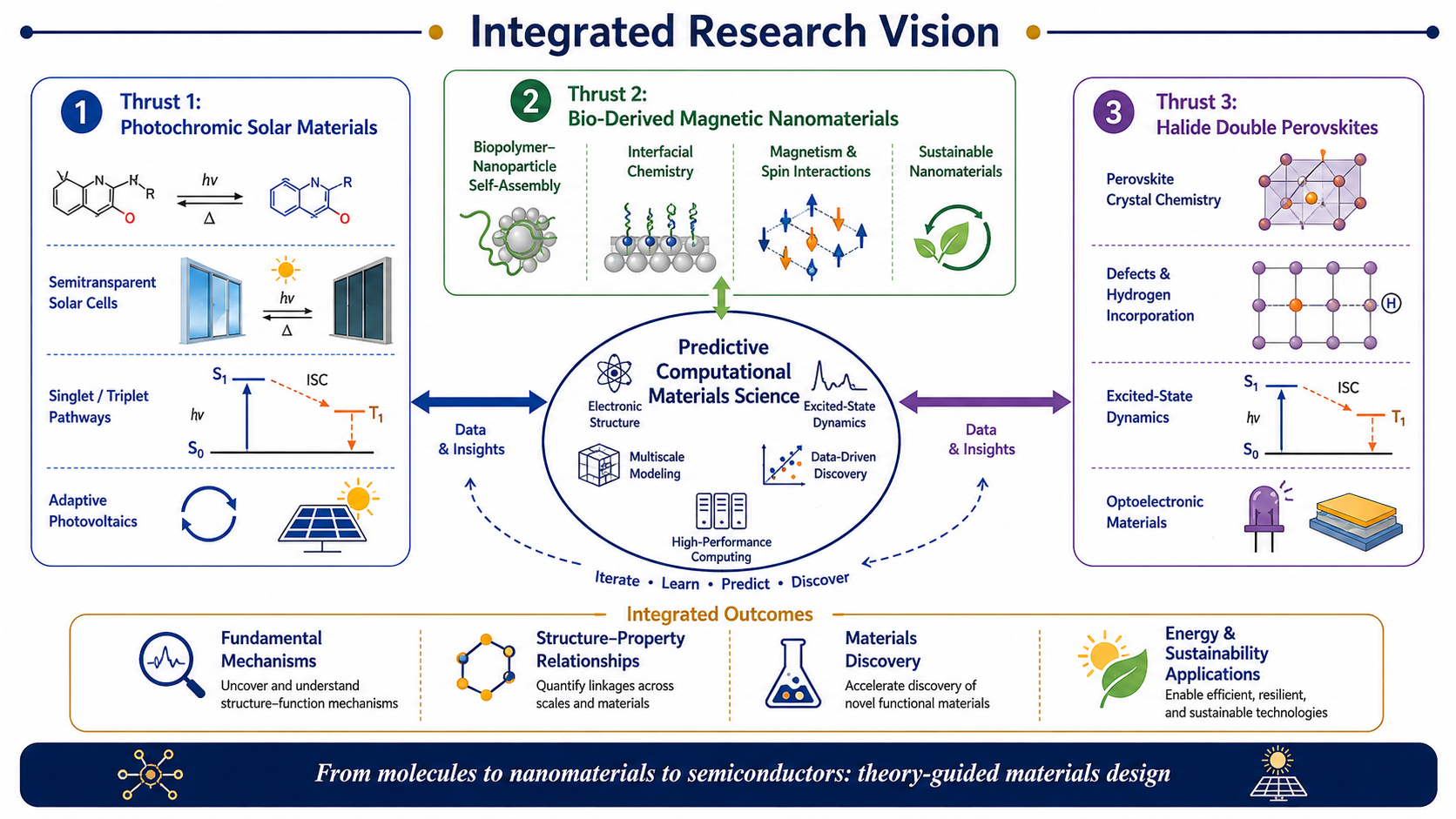
Computational Photochemistry & Photoresponsive Materials. (molecular scale)Our research aims to uncover the fundamental molecular mechanisms that govern light-responsive photochromic materials for next-generation semitransparent solar energy technologies. By integrating computational chemistry, quantum-mechanical modeling, and experimental collaborations, we investigate how molecular structure, excited-state dynamics, and interfacial interactions govern reversible photochromic switching, charge transfer, and long-term photostability. Particular emphasis is placed on understanding the roles of singlet and triplet excited states, conical intersections, and structure–property relationships that dictate device performance. Through predictive molecular design, our goal is to establish design principles for smart photoactive materials that simultaneously harvest solar energy, dynamically regulate optical transparency, and enable adaptive building-integrated photovoltaics and other sustainable energy applications.
Bio-Derived Magnetic Nanomaterials & Interfacial Self-Assembly. (nano/biointerface scale) Our research seeks to establish a predictive understanding of how molecular interactions govern the self-assembly, interfacial behavior, and emergent properties of bio-derived magnetic nanomaterials. By combining multiscale computational modeling, quantum chemistry, molecular dynamics, and data-driven approaches with experimental validation, we investigate the fundamental mechanisms that control surface functionalization, nanoparticle organization, and biointerface interactions. A central objective is to elucidate how atomic- and molecular-scale phenomena translate into macroscopic magnetic, mechanical, and physicochemical properties, enabling the rational design of sustainable nanomaterials from renewable biopolymers. This research provides a computational framework for engineering next-generation bio-derived magnetic materials with tailored performance for environmental remediation, energy technologies, sensing, catalysis, and biomedical applications.
Computational Discovery of Functional Semiconductors. (crystalline materials scale)Our research focuses on developing predictive computational frameworks to accelerate the discovery and design of next-generation halide double perovskites (HDPs) for sustainable optoelectronic and photovoltaic technologies. By integrating first-principles electronic-structure methods, many-body perturbation theory, electron–phonon coupling calculations, and high-performance computing, we investigate how atomic-scale phenomena—including cation ordering, point defects, hydrogen incorporation, and lattice dynamics—govern the electronic structure, charge-carrier transport, exciton dynamics, and photophysical behavior of these materials. Our goal is to establish quantitative structure–property relationships that connect chemical composition and crystal architecture to functional performance, enabling the rational design of stable, lead-free semiconductor materials with enhanced charge transport, defect tolerance, and light-harvesting efficiency. Through computational materials discovery, this research advances fundamental understanding while providing design principles for high-performance semiconductors for photovoltaics, light-emitting devices, radiation detection, and quantum optoelectronics.